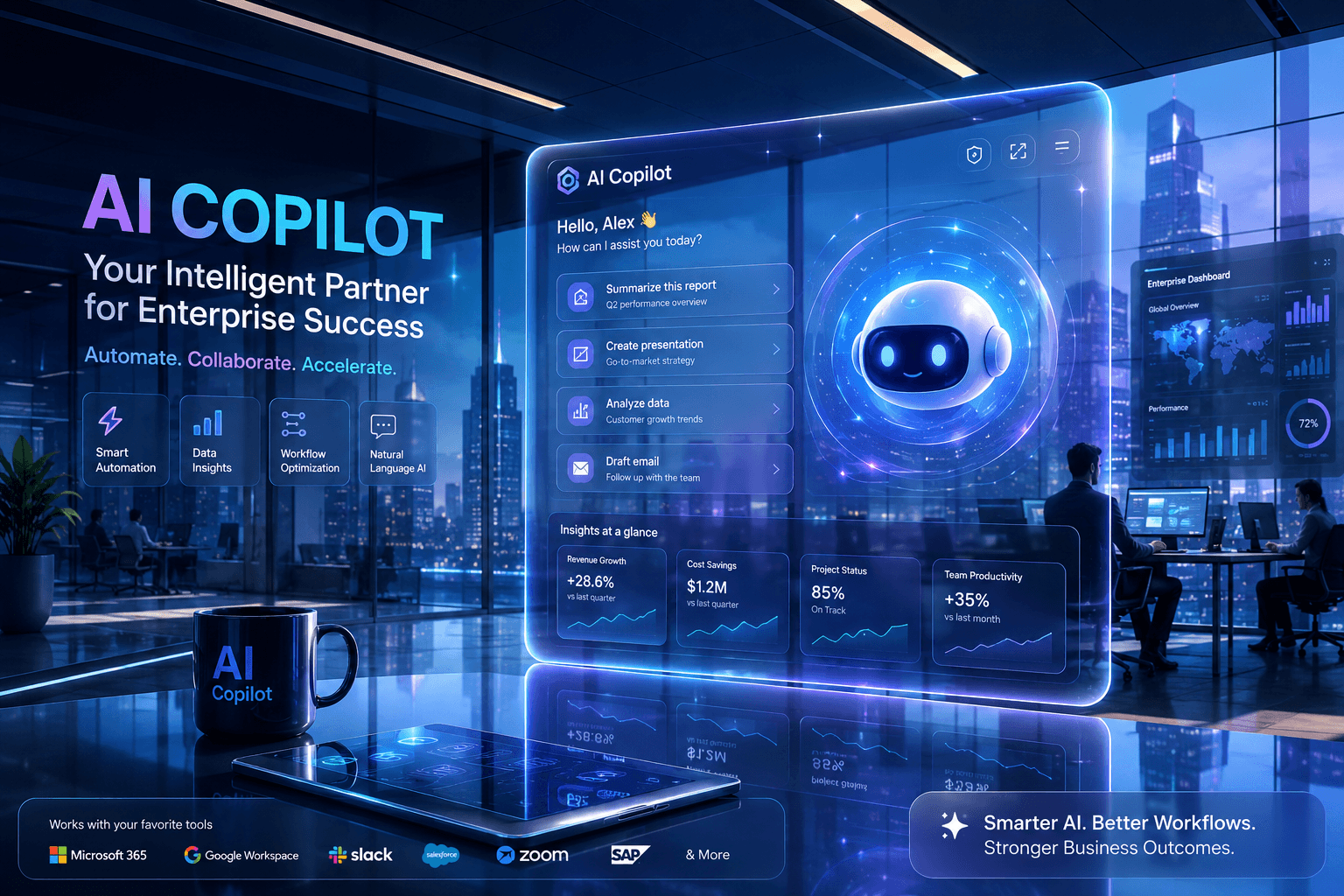
Enterprise Agentic AI Copilots: How Context‑Aware AI Eliminates Workflow Bottlenecks in 2026
Why Agentic AI Copilots Matter
Search interest in agentic AI and AI copilots has surged in 2026, with executives worldwide asking, “What is agentic AI and how do I deploy it?” The shift from simple chatbots to autonomous agents is one of the top enterprise technology trends. C-suite leaders are moving beyond pilots toward production-grade AI that integrates seamlessly into existing workflows and delivers measurable business value. In this article, we explain what agentic AI is, why context-aware copilots are essential for enterprise automation and how your organization can leverage them to reduce cycle times and improve ROI.

What Is Agentic AI?
Agentic AI refers to AI systems that not only generate text but also perform tasks on behalf of users. Unlike traditional chatbots, agentic systems can reason, retrieve information, make decisions and call external APIs within defined policies. This multi-step capability turns AI into a digital coworker that executes work rather than just answering questions.
Key Characteristics of Agentic AI
1. Multi-System Integration: Agents connect to CRMs, ERPs, HR systems and SaaS tools to fetch and update data automatically.
2. Autonomous Decision-Making: They can choose the best action among alternatives while adhering to company policies and regulatory rules.
3. Continuous Learning: Agents learn from interactions to improve performance over time.
4. Context Awareness: Using retrieval-augmented generation (RAG), agents maintain context across conversations by pulling relevant information from databases and documents.
These attributes enable agentic AI to automate complex workflows (e.g., invoice processing, lead qualification, procurement approvals) and deliver outcomes without constant human oversight.

How Context-Aware Copilots Work: Architecture & Components
To function effectively in enterprise environments, context-aware AI copilots rely on a modular architecture:
1. Retrieval-Augmented Generation (RAG)
Agents combine large language models with vector databases to search organizational knowledge bases, CRMs and ERP records in real time. By retrieving relevant context before generating a response, copilots reduce hallucinations and ensure answers are grounded in up-to-date information.
2. Orchestration Layer
An orchestration engine coordinates tasks across multiple systems. It maintains conversation state, manages API calls and ensures that each operation is executed in the correct order. Platforms such as Sana and Workato provide workflow orchestration for AI agents.
3. Policy & Permissioning
Enterprise AI must respect data privacy and security. A policy engine enforces role-based access control, redacts sensitive fields, logs all actions and integrates with data loss prevention (DLP) tools.
4. User Interface (UI) Layer
Copilots interact with users via natural language chat or embed themselves into existing applications. They can appear within CRM dashboards, email clients or Slack channels, providing contextually relevant actions.
These components together enable AI to understand the task context, fetch the right data, execute actions and deliver results securely.

Context-aware AI workflow showing enterprise data sources connected to an executive AI copilot.
Top Enterprise Use Cases & ROI in 2026
Agentic AI is transforming operations across industries. Here are high-ROI use cases reported by leading enterprises:
Use Case: Sales & Lead Qualification
How the Copilot Works: The copilot pulls leads from CRM, enriches them with external data, prioritizes based on purchase signals and drafts personalized outreach.
Business Impact: Reduces lead qualification time by up to 80% and increases conversion rates.
Use Case: Finance & Invoicing
How the Copilot Works: The agent retrieves purchase orders, matches invoices to contracts, approves payments within pre-set thresholds and logs transactions in ERP.
Business Impact: Cuts invoice processing cycle time from days to hours and reduces errors.
Use Case: HR & Recruiting
How the Copilot Works: Copilots screen resumes, schedule interviews and generate offer letters while ensuring compliance with hiring policies.
Business Impact: Decreases time-to-hire and improves candidate experience, leading to better talent acquisition.
Use Case: IT & Support Automation
How the Copilot Works: Agents triage support tickets, auto-resolve common issues using knowledge bases and assign complex problems to specialists.
Business Impact: Lowers support workload and improves mean time to resolution (MTTR).
Enterprises report unit cost reductions, faster cycle times and higher customer satisfaction when deploying AI agents.
Governance & Secure Integration
Scaling AI requires robust governance and data quality frameworks. CIOs and CISOs emphasize that governance gaps and data lineage issues are the biggest obstacles to production deployments. To ensure compliance and trust:
Data Quality & Lineage: Build reliable data pipelines and track data provenance so that agents always work with clean, trusted information.
Redaction & DLP: Implement automated redaction of sensitive fields (e.g., PII, financial data) and integrate data loss prevention tools to prevent leakage.
Audit Trails: Log every action an agent performs and maintain immutable audit records for regulatory compliance.
Role-Based Access Control: Enforce fine-grained permissions to ensure agents only access data they are authorized to use.
Regular Review: Periodically evaluate agent outputs and retrain models to mitigate bias and hallucinations.
By following these measures, enterprises can deploy agentic AI with confidence, meeting regulatory requirements and maintaining customer trust.

AI governance and security system with compliance, privacy, redaction and access control layers.
Getting Started: A C-Suite Checklist
For CEOs, CTOs and COOs considering agentic AI, here’s a step-by-step checklist:
1. Identify High-Impact Workflows: Target processes with clear ROI potential and measurable KPIs (e.g., cycle time, error rates, customer satisfaction).
2. Assess Data & Systems: Evaluate the quality, completeness and accessibility of your data sources and integration points.
3. Choose the Right Platform: Decide whether to use a workday-native OS (Sana), a horizontal automation tool or a low-/no-code builder.
4. Define Policies: Establish governance policies, access controls and compliance requirements from the outset.
5. Pilot & Measure: Begin with a contained pilot, measure ROI and iterate before scaling to more workflows.
6. Invest in Change Management: Train staff, update processes and build cross-functional teams to oversee AI deployment.
Conclusion
Agentic AI copilots are not just a buzzword; they are a strategic priority for enterprises in 2026. By integrating AI directly into core systems and empowering agents with retrieval-augmented context and strong governance, organizations can eliminate workflow bottlenecks, reduce costs and enhance customer experiences. The opportunity is vast—but success depends on careful planning, robust data foundations and a focus on measurable outcomes.
To stay ahead, continue monitoring AI trends, experiment with pilot projects and collaborate with trusted partners like Genvorex AI who specialize in custom LLM development, workflow automation and AI governance.