
RAG vs Fine-Tuning vs Custom LLM Development: Which Enterprise AI Strategy Delivers Better ROI in 2026?
Why Enterprise Buyers Need the Right AI Architecture Decision
Most enterprise AI projects do not fail because the model is weak. They fail because the architecture is wrong for the business problem. A company uses a generic model for a domain-heavy workflow, fine-tunes a model for knowledge that changes every week, or builds a retrieval layer without governance, permissions, and auditability. In 2026, the real executive question is no longer “Should we use AI?” It is “Which AI architecture will create measurable business value without creating new operational risk?”
That question matters because enterprise adoption is moving from pilots to production. Deloitte reports that worker access to AI rose sharply in 2025 and that the number of companies with a large share of projects in production is expected to rise further. McKinsey’s 2025 global survey also shows that the organisations getting the most value from AI are redesigning workflows rather than treating AI as a side experiment.

What Is the Difference Between RAG, Fine-Tuning, and Custom LLM Development?
RAG
RAG, or retrieval-augmented generation, gives an AI system access to external knowledge at the moment a user asks a question. Instead of relying only on what the base model learned during training, the system retrieves relevant content from documents, databases, or knowledge bases and uses that content to generate a grounded answer. This makes RAG especially useful when your information changes frequently, when answers must cite internal sources, or when accuracy depends on current company data.
Fine-Tuning
Fine-tuning changes the model’s behaviour by training it on examples of the inputs and outputs you want. It is most useful when the business needs a consistent format, a specialised tone, a controlled response style, or more reliable performance on a narrow task. OpenAI describes supervised fine-tuning as a way to produce more reliable style and content for a specific use case, while Cohere positions fine-tuning as the right choice when you want to tailor results to domain language and task behaviour rather than keep injecting updated knowledge.
Custom LLM Development
Custom LLM development is the broader enterprise route. It usually combines model selection, prompt design, retrieval, fine-tuning where justified, security controls, orchestration, evaluation, and integration with business systems such as CRM, ERP, document stores, and internal APIs. In other words, a custom LLM project is not just “training a model”. It is designing a production AI system around a high-value workflow.
When Should an Enterprise Use RAG?
Use RAG when the answer depends on information your business already owns and that information changes over time. Contract terms, operating procedures, knowledge-base content, product documentation, policy manuals, price books, and support records are all strong RAG candidates. RAG is usually the fastest route to value because it lets you connect the model to trusted content without retraining the base model every time the underlying knowledge changes.
RAG is also the right choice when source attribution matters. Anthropic’s documentation highlights natural citations for search-based applications, and its contextual retrieval work reports significantly fewer failed retrievals when contextual embeddings and contextual BM25 are used together, with further gains from reranking. For enterprise buyers, that matters because retrieval quality drives trust, and trust drives adoption.
When Should You Fine-Tune an LLM?
Fine-tune when the task is stable, repetitive, and strongly dependent on response behaviour. If you need the model to draft insurance correspondence in a controlled format, classify legal intake using specific labels, produce consistent procurement summaries, or follow a house style across thousands of outputs, fine-tuning can reduce prompt complexity and improve consistency.
Do not treat fine-tuning as the default solution for fresh business knowledge. If the underlying facts change every week, RAG is normally the more economical and maintainable option. Even practitioners on Reddit repeatedly describe the two as serving different purposes: RAG for current knowledge and fine-tuning for behaviour, structure, and consistency. That distinction is also reflected in official vendor guidance.
When Should You Build a Custom LLM Instead of Buying an Off-the-Shelf Tool?
Build a custom LLM solution when the business case involves proprietary data, internal workflows, regulated content, or measurable ROI tied to execution rather than chat. Off-the-shelf tools are good for general productivity. They are weaker when the organisation needs deep integration with internal systems, role-based permissions, custom evaluation, and process automation across multiple steps. Gartner says organisations with successful AI initiatives invest far more heavily in data and analytics foundations, which is exactly what custom implementation enables.
This is why the most commercially valuable enterprise AI work now sits at the intersection of integration, governance, and workflow redesign. McKinsey’s enterprise findings point to redesigning workflows as a major success factor, while Reuters recently reported that many firms are adopting generative AI but still struggle to translate adoption into visible productivity gains. The lesson for buyers is simple: value does not come from buying access to a model. It comes from fitting the model into a workflow that already matters.
The Genvorex BRIDGE Framework for Choosing the Right Path
Business Outcome
Start with a single target outcome: lower handling time, lower service cost, faster onboarding, improved conversion, fewer escalations, or faster document processing. If the project does not have an owned metric, it is not ready for production.
Risk and Regulation
Next, map the risk profile. If the workflow touches sensitive customer data, legal documents, financial records, or regulated decisions, architecture and access controls matter from day one.
Information Freshness
Then ask how often the knowledge changes. If the answer is daily, weekly, or monthly, retrieval should usually be the foundation. If the task depends on stable output behaviour, fine-tuning becomes more attractive.
Domain Behaviour
Evaluate whether the model must speak your domain language, follow a house style, or return structured outputs. That is where fine-tuning or a tightly designed response layer adds value.
Governance and Integration
Finally, assess permissions, auditability, system integrations, and evaluation. A useful enterprise AI system is not just intelligent. It is observable, secure, and connected to the systems where work happens.
Economics
The final executive check is cost-to-value. Anthropic’s productivity research estimates substantial time savings on real-world tasks, and McKinsey continues to show large economic potential from generative AI across business functions. But the board-level decision should still come down to your expected cost per task, labour hours saved, error reduction, and speed to deployment.
What Does a Secure Enterprise AI Architecture Look Like?
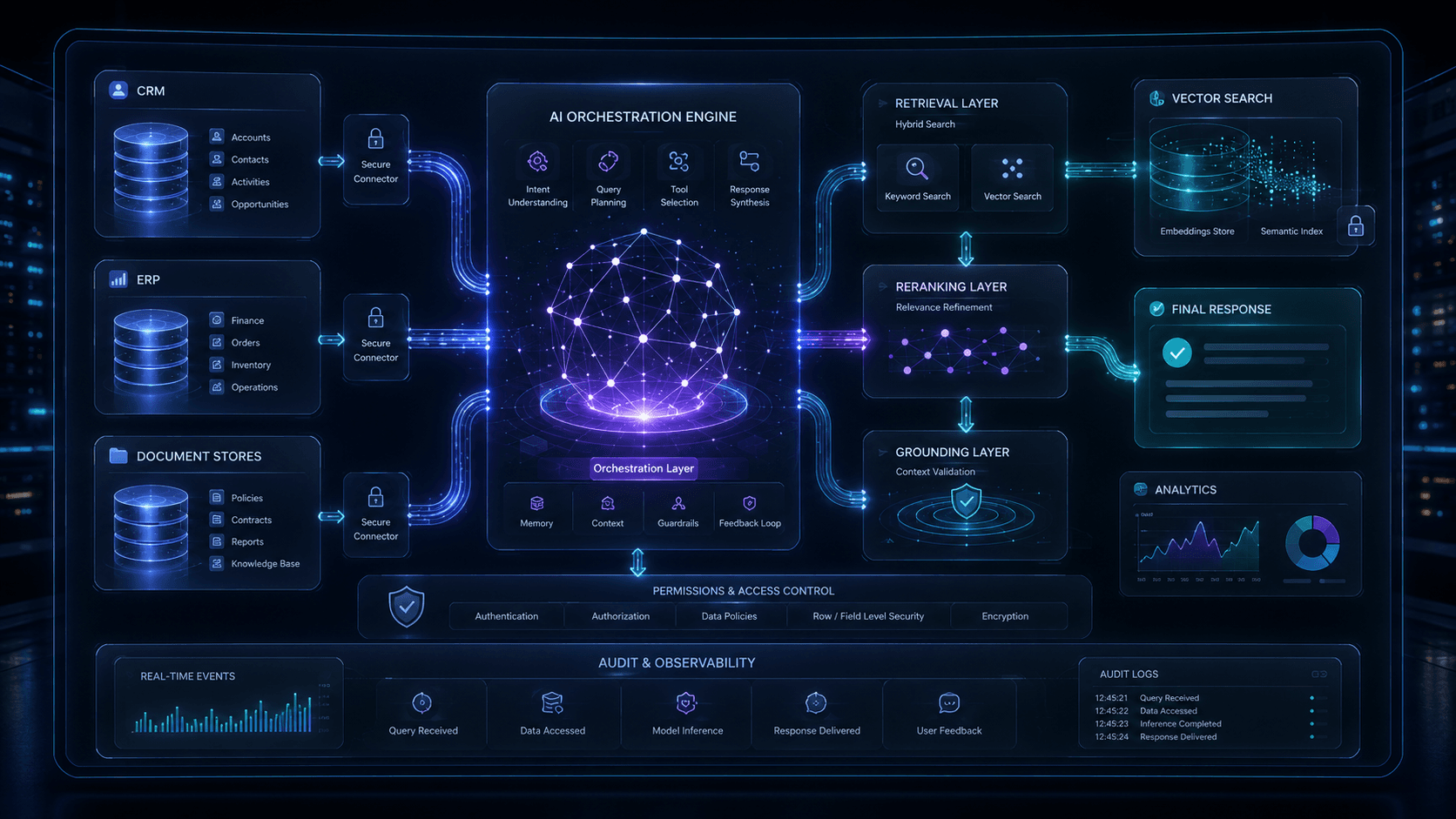
For most companies, the winning architecture is not “RAG only” or “fine-tuning only”. It is a layered system: trusted data sources, controlled ingestion, retrieval and reranking, model orchestration, optional fine-tuning for behaviour, and a governance layer that enforces permissions, logging, and human review where needed. OpenAI’s file search and function-calling documentation, Anthropic’s context engineering guidance, and Cohere’s enterprise search and RAG guidance all point in this same direction: enterprise value comes from combining model intelligence with grounded data and controlled actions.

This flow is consistent with current enterprise implementation patterns documented by OpenAI, Anthropic, and Cohere, and it gives non-technical buyers a visual way to understand why enterprise AI is an architecture decision rather than a single-model purchase.
What ROI Should a CEO, CTO, or COO Measure?
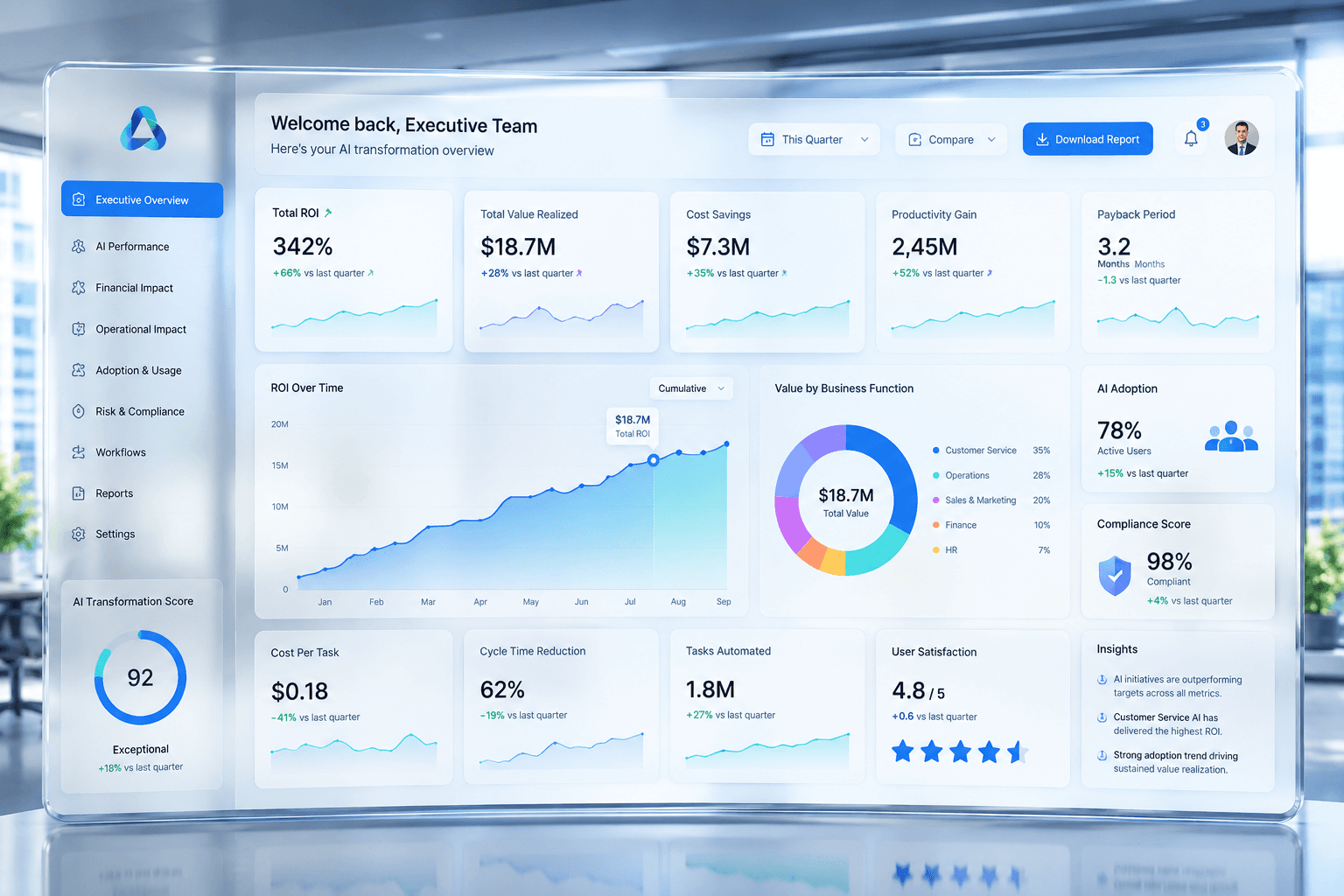
The most credible AI business cases are not built on vague promises. They are built on workflow metrics. Measure cycle time, cost per completed task, first-response time, escalation rate, accuracy against a human-reviewed benchmark, employee adoption, and time to value. Deloitte, Gartner, and McKinsey all point in the same direction: scale comes from disciplined foundations, redesigned workflows, and explicit management practices rather than tool enthusiasm alone.
For practical planning, many enterprise buyers should expect RAG-led projects to deliver faster initial deployment, while fine-tuning-led projects may take longer but improve consistency for narrow, repeated tasks. A custom LLM programme can create the highest strategic value when it combines both approaches around a workflow that already has budget visibility. That is the difference between a demo and a deployable system.
Frequently Asked Questions Enterprise Buyers Ask Before Hiring an AI Agency
Is RAG enough for enterprise AI?
Sometimes, yes. If your main problem is that the model lacks access to current internal knowledge, RAG is often the fastest and safest place to start. If your problem is consistency of output, brand tone, or specialised task behaviour, you may need fine-tuning as well.
How do we connect AI to internal company data securely?
Use permission-aware ingestion, role-based access, redaction where necessary, logging, and a governance layer that controls which tools and systems the model can access. Search-enabled systems also need strong retrieval quality, because weak retrieval is one of the fastest ways to reduce trust in production.
Should we buy an enterprise AI platform or hire a custom AI agency?
If the workflow is generic, a platform may be enough. If the workflow is tied to proprietary data, compliance requirements, multiple internal systems, or a board-level ROI target, a custom agency engagement is usually the better route because implementation quality matters more than model access.
How much does custom LLM development cost?
The exact cost is organisation-specific and depends on scope, integration depth, data preparation, evaluation, security requirements, and whether fine-tuning is needed. The better executive question is not “What is the cheapest model?” but “What architecture reaches production safely and pays back fastest?” Reuters’ recent reporting on enterprise spending controls shows that cost governance is now an active priority for enterprise buyers.
Conclusion
The best enterprise AI strategy in 2026 is not a universal winner between RAG, fine-tuning, and custom LLM development. The winning strategy is choosing the right combination for the workflow, the data, and the level of business risk. RAG is usually best for current knowledge. Fine-tuning is usually best for stable behaviour. Custom LLM development is the right path when the company needs a production system built around its own processes, data, and controls.
For enterprise buyers, that is the real shortlist. Not hype versus scepticism. Not build everything versus buy everything. The right question is which architecture will create measurable value first, and which partner can implement it with security, governance, and commercial discipline. That is where Genvorex AI should position itself.**
This draft is intentionally built around question-led headings, comparison intent, and executive decision language because Google’s AI-search guidance and current SEO studies both indicate that deeper, more specific answers and aligned fan-out coverage improve visibility in AI-driven search experiences.