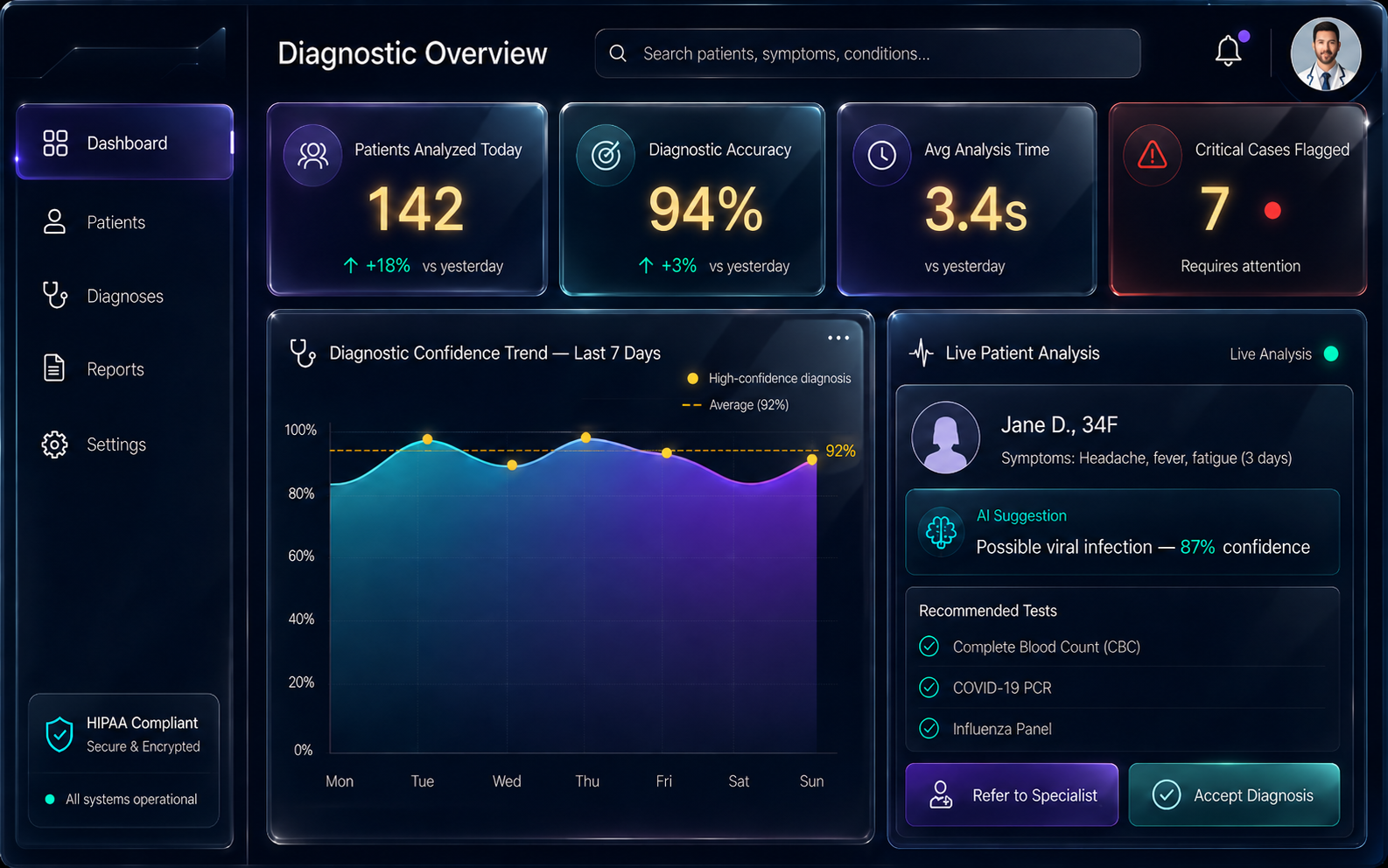
AI Doctor Diagnostic Assistant
An AI clinical assistant that analyzes patient symptoms, references medical knowledge bases in real-time, and surfaces differential diagnoses to doctors — speeding up clinical decisions and reducing diagnostic errors in busy hospital environments.

The Challenge
Doctors were drowning in information overload.
In high-volume hospital settings, physicians face an impossible task — review patient history, recall the latest clinical guidelines, consider rare conditions, and arrive at the right diagnosis under intense time pressure. With medical knowledge doubling every few years, no human can keep up.
Diagnostic errors affect millions of patients each year. Junior doctors lack the experience to consider all possibilities. Senior doctors are stretched thin. Hospitals needed a way to augment clinical reasoning — not replace doctors, but support them with instant access to relevant medical knowledge and pattern-matching across thousands of similar cases.
Our Solution
Clinical intelligence that augments expert doctors.
We built a RAG-powered diagnostic assistant that integrates with hospital EHR systems, analyzes patient presentations in real-time, and provides evidence-backed differential diagnoses with confidence scores — all in seconds.
Symptom-driven analysis
Natural language input — doctors describe what they see, the AI extracts structured clinical findings.
Medical knowledge RAG
Pulls from PubMed, clinical guidelines, and hospital protocols — every suggestion is evidence-backed and citable.
Confidence scoring
Each diagnosis comes with a probability score and recommended tests to confirm or rule out the condition.
Safety-first design
Never replaces clinical judgment. Flags critical cases, escalates uncertainty, and logs every recommendation for review.
How It Works
The architecture behind every diagnosis.
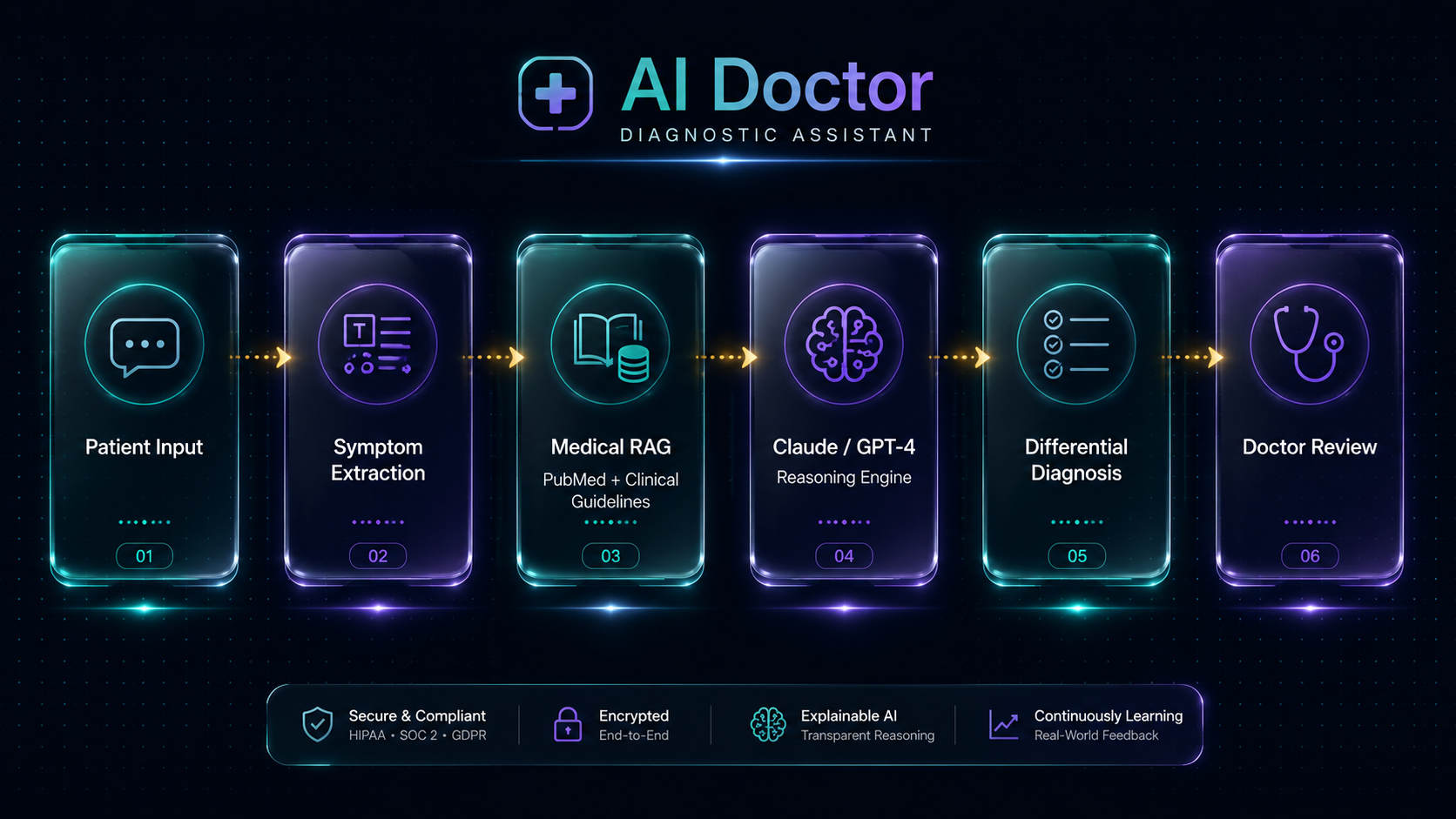
Patient symptoms flow from EHR input through NLP extraction, then a medical RAG layer retrieves relevant clinical guidelines and case studies. Claude reasons over the evidence, generates a ranked differential diagnosis with confidence scores, and surfaces the result to the doctor — typically in under 4 seconds.
The Results